


CamVac
Knowledge Hub
-

CamVac Series
-

Made in Britain
-

Made in Sheffield
Inlet Size and Reducers – What Really Matters and Why
Inlet size and reducers determine how much airflow the machine can handle efficiently – and that matters.
Key Takeaways
If you read nothing else, read these. They are the conclusions of this article – not teasers for what is coming.
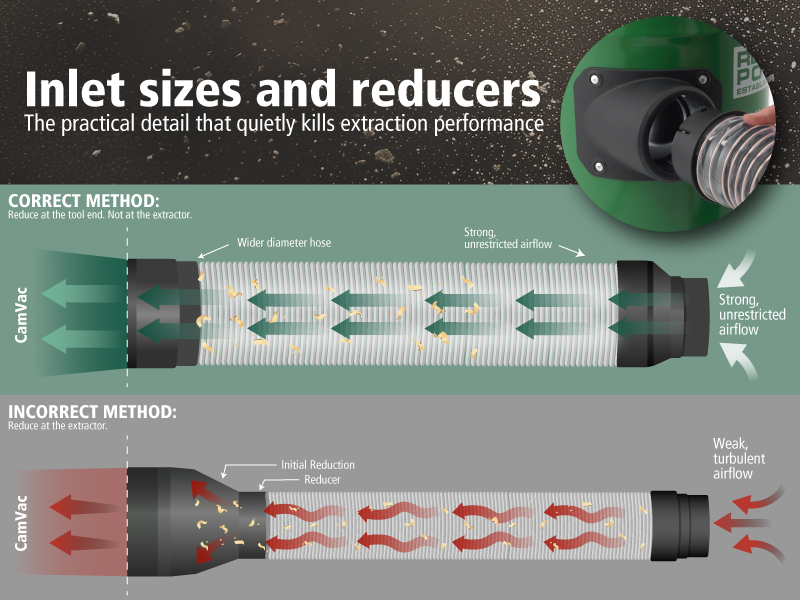
- Reduce at the tool end – not at the extractor inlet. Choking the inlet restricts airflow at every point downstream.
- A large-inlet extractor reduced gradually to a small tool outlet maintains strong airflow throughout. A small-inlet machine cannot compensate with adapters fitted upstream.
- The recommended reduction sequence for CamVac is: 100mm inlet, 100mm hose where possible or minimum 63mm hose, then reduce further only at the tool connection.
- Compact power tool extractors with small native inlets are not effective when asked to serve large-outlet stationary machines – the restriction is built in regardless of what is attached.
- Start as large as you can and only reduce where you have no choice – at the tool.
In Brief
Hose diameter and reducer placement have a larger effect on extraction performance than most woodworkers expect. The principle is simple: start as large as possible and reduce only at the tool end – never at the extractor inlet. A 100mm extractor stepped down gradually to 38mm at the tool can maintain strong performance throughout. The same extractor reduced to 32mm at the inlet restricts the whole system before airflow even enters the hose. Understanding this principle also explains why a large-inlet workshop extractor can serve tools with small ports effectively, while a compact extractor with a small native inlet cannot be made to work well with large machines regardless of what adapters are fitted.
What This Article Covers
This article takes around four minutes to read in full. Use the links below to jump to any section.
- Why Inlet Size Matters – How the extractor inlet sets the performance baseline for the whole system
- The Right Way to Reduce – The key principle – and why it applies regardless of system type
- Why We Favour 100mm to 63mm Reductions – The practical reasoning behind the recommended hose sequence
- How Different Setups Perform in Practice – A direct comparison of common configurations
- Common Questions – The questions we are asked most often
- Honest Limitations of This Article – What this article covers – and what it does not
- Further Reading – The companion articles that go deeper
Why Inlet Size Matters
The inlet size of an extractor sets the ceiling for how much airflow the system can handle – and that ceiling applies to the whole duct run, not just the connection point.
This is why two HPLV systems can behave very differently when asked to serve the same tool:
- A CamVac workshop extractor with a 100mm (4 inch) inlet is designed to handle the full range of workshop airflow needs. It can be stepped down through the hose to serve smaller tools.
- A compact power tool extractor typically has an inlet of around 27 to 36mm, optimised for handheld tool use. Its airflow capacity is already constrained where the pressure and pull is created and affects everything downstream.
Both systems may use HPLV technology. But their inlet diameters mean they are suited to different scales of use – and no adapter fitted upstream of a small extractor inlet can compensate for the restriction built into the inlet itself.
The Right Way to Reduce
The principle is straightforward: reduce at the tool end, not at the extractor inlet.
When you reduce the hose diameter close to the tool – where the tool outlet itself is already the restriction point – you are working with the system rather than against it. The large inlet and main hose section maintain full airflow potential; only the final connection narrows to match the tool.
When you reduce at the extractor inlet instead, you create a restriction at the point of maximum consequence – airflow is already throttled before you even attach a hose or connect to a waste producing machine.
Think of it like drinking through a straw: a wide straw that narrows only at the tip delivers good flow. A narrow straw the whole length restricts flow throughout – no matter how hard you draw.
Why We Favour 100mm to 63mm Reductions
In our experience, reducing directly from 100mm to 32mm at the extractor inlet restricts airflow even on high-pressure systems – the step-down approach through an intermediate hose size performs significantly better.
Some systems offer 100mm-to-32mm reducers intended to be fitted directly at the extractor inlet. In practice, we have found that this degree of reduction at the inlet chokes the system even when static pressure is high – the restriction is simply too severe.
The approach we recommend is:
- Use the full 100mm inlet on the extractor.
- Where you cannot use 100mm connecting hose – step down to a minimum 63mm hose – this gives good handling flexibility and maintains strong airflow through most of the run.
- Reduce further only at the tool connection, using appropriate adapters to match the tool’s outlet size.
This graduated approach maximises airflow at each stage rather than creating a single severe restriction point.
How Different Setups Perform in Practice
The table below compares common configurations and their likely real-world performance.
Setup | Result |
CamVac 100mm inlet – 63mm hose – reduce at tool end | Good airflow throughout. Effective fine dust capture at the tool. |
CamVac with 100mm-to-32mm reducer at the inlet | Airflow significantly restricted. Performance well below system capability. |
Compact extractor (27-36mm inlet) serving a 100mm machine outlet | Airflow limited by inlet from the start. Likely clogging and poor capture. |
Common Questions
These are the questions we are asked most often.
Can I use my compact power tool extractor with my table saw or planer?
Generally, compact power tool extractors are not well-suited to stationary machines for two reasons. First, the small native inlet limits airflow capacity regardless of what is attached upstream. Second, the filter and collection capacity of compact units is designed for the lower waste volumes produced by handheld tools – machines like table saws and planers generate significantly more material and can overwhelm a compact system quickly. For stationary machines, a workshop-scale extractor with an appropriate inlet size is the more effective choice.
I have a 100mm extractor inlet but my tool has a 27mm outlet – what is the best connection approach?
The recommended approach is to run 100mm duct from the extractor, use 100mm hose to connect where you can and step down only to 63mm hose where necessary, and use a 63mm-to-27mm adapter at the tool connection point. This keeps the restriction as close to the tool as possible and maintains strong airflow through the main hose section. If a 63mm-to-27mm adapter is not available for your specific tool, a 63mm-to-32mm adapter followed by a short 32mm hose to the tool is a reasonable alternative.
Does hose length affect performance significantly?
Yes – longer hose runs increase resistance, which reduces airflow. The degree of reduction depends on the static pressure of the system: a higher-pressure system maintains more of its performance over a longer run than a low-pressure one. Keeping hose runs as short as practical, minimising bends, and ensuring the hose diameter is appropriate for the run length all help maintain performance. As a general principle, if you need a long run, use a larger hose diameter for the main section and reduce only at the tool end.
Does the type of hose matter, or just the diameter?
Both matter. Smooth-bore hose offers less resistance than corrugated flexible hose – for long fixed runs where the hose will not be moved, smooth-bore ducting is worth considering for the main section. Corrugated flexible hose is more practical for the last metre or two where movement is needed. The inside diameter is the primary factor for airflow capacity; the material and surface texture affect friction losses, which matter more over longer runs.
Honest Limitations of This Article
This article covers hose diameter and reducer placement. It does not cover full workshop duct system design.
The principles here apply to connecting a single extractor to one or two machines via flexible hose. Designing a fixed duct system serving multiple machines simultaneously – with blast gates, branch connections, and balanced airflow across the workshop – involves additional considerations that are beyond the scope of this article. For multi-machine fixed installations, specialist duct design guidance is worth seeking.
Further Reading
Each of the following articles covers a specific aspect of dust extraction in depth. They are written to stand alone.
Understand the risk and the science:
> The Dangers of Wood Dust for Woodworkers – Why dust protection matters and what the health evidence says.
> Why Microns Matter: Understanding Dust Filtration for Woodworkers – What filter ratings actually measure, and what efficiency in the PM2.5 range means in practice.
Understand how extractors work:
> Airflow – Critical or Confusing? – Why the CFM figure on a spec sheet may not reflect real-world performance.
> HVLP or HPLV – What Are the Differences and Why Do They Matter? – The extractor type question that determines what dust your machine can actually capture.
> Inlet Size and Reducers – What Really Matters and Why – How hose setup affects what your extractor can actually capture.
The complete guide:
> Dust Extraction Buyer’s Guide – A decision framework for choosing and setting up the right system for your workshop.


Related Posts
Discover more...
If you’ve enjoyed reading this guide, why not take a look at some of our blogs?